
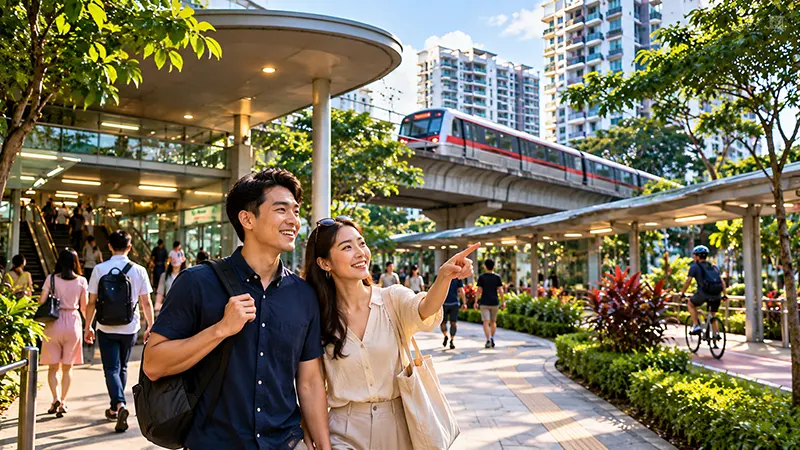
Public transport accessibility is an important consideration when purchasing residential property in Singapore. For many households, living near an MRT station can simplify daily commuting, reduce dependence on private vehicles and provide convenient access to employment centres, shopping destinations and educational institutions.
In northern Singapore, the North-South Line plays a particularly important role in connecting established residential towns with the rest of the island. Yishun, Khatib, Canberra and Sembawang are among the locations served by this rail corridor.
However, choosing a property based on MRT proximity involves more than checking the distance between a condominium and the nearest station. Buyers should understand the wider transport network, walking routes and their own commuting requirements.
1. Why the North-South Line Matters to Northern Residents
The North-South Line is one of Singapore’s established MRT corridors. It connects northern residential communities with major destinations, including the city centre and commercial districts.
For residents of Yishun and Sembawang, this connection offers an alternative to relying exclusively on buses or private transport.
Yishun MRT station serves an established residential and commercial town centre. Nearby facilities include shopping destinations, food outlets and everyday services. Khatib MRT station provides another transport option for residents in the southern part of Yishun.
Further north, Canberra and Sembawang stations serve residential communities with their own neighbourhood amenities.
The value of this connectivity depends on where residents regularly travel. Someone working near an MRT interchange may benefit from a convenient rail connection, while a person employed in an area with limited rail access may still need additional bus journeys.
Therefore, buyers should examine their actual commuting routes rather than assuming that every property along the same MRT line offers identical convenience.
2. Understanding the Difference Between MRT Distance and Accessibility
Property advertisements frequently highlight distances to nearby MRT stations. While this information is useful, buyers should understand how the distance translates into everyday travel.
A development advertised as being within walking distance of an MRT station may still involve road crossings, uncovered pathways or indirect pedestrian routes.
During a property visit, consider checking:
- The actual walking route from the development entrance to the station.
- Whether sheltered walkways are available.
- The number of major road crossings involved.
- Whether bus services provide an alternative connection.
- The accessibility of the route for elderly residents and young children.
These factors can make a noticeable difference to daily convenience.
The planned Chencharu Central Residences development in Yishun provides an example of a residential project with several transport-related considerations. Located at Chencharu Close, it is approximately 0.45 to 0.49km from Khatib MRT station.
The proposed development also incorporates a bus interchange, which could provide residents with additional public transport options. A hawker centre and retail facilities are also planned as part of its mixed-use arrangement.
For prospective purchasers, the combination of rail connectivity and proposed bus services offers useful points for evaluating the development’s accessibility.
3. Canberra and Sembawang: Connectivity Beyond the Town Centre
Sembawang has developed into an established residential area with access to the North-South Line. Canberra MRT station provides another transport option for households living around the surrounding estates.
One planned residential project in this area is Fablewoode Residences, an executive condominium on Sembawang Road. The development is expected to comprise approximately 265 low-rise homes and is around 0.5km from Canberra MRT station.
Its location next to the Sungei Simpang Kanan park connector also introduces a recreational dimension to the surrounding environment.
For buyers considering this part of Singapore, it is worth examining how MRT access connects with other neighbourhood facilities. A convenient rail journey is valuable, but access to supermarkets, schools, healthcare services and recreational spaces also contributes to residential suitability.
Canberra and Sembawang offer different neighbourhood environments, so prospective homeowners should explore both areas before deciding which location better suits their household.
4. Does Living Near an MRT Station Always Mean Better Property Value?
MRT proximity is frequently considered a desirable property characteristic, but buyers should avoid assuming that every property near a station will experience stronger price appreciation.
A convenient transport connection may support a property’s appeal to certain groups of homeowners and tenants. However, actual market performance depends on multiple factors.
These include:
- The property’s purchase price relative to comparable developments.
- Age and condition of the building.
- Unit layout and available facilities.
- Surrounding commercial and residential amenities.
- Supply of competing properties.
- Broader economic and property market conditions.
Noise is another consideration. Properties located very close to railway infrastructure or major transport roads may experience different environmental conditions from developments situated further away.
Buyers should therefore evaluate the advantages of accessibility alongside potential disadvantages.
An MRT connection should be treated as one component of a property’s overall suitability rather than a guarantee of investment performance.
5. How to Evaluate a Property’s Transport Advantages
Before committing to a condominium purchase, conduct a practical assessment of the surrounding transport network.
Start by identifying the nearest MRT station and the relevant train line. Then consider how many transfers are required to reach frequently visited destinations.
Next, investigate bus connections. Direct bus services may offer convenient alternatives for shorter journeys that are not efficiently served by the MRT network.
It is also useful to visit the neighbourhood during morning and evening peak periods. This can help buyers understand pedestrian movement, traffic conditions and the general accessibility of the area.
Families should consider whether children can travel independently and whether essential destinations are reachable without complicated transfers.
Finally, compare the transport arrangements of different developments rather than focusing on one advertised distance.
Making Connectivity Part of Your Property Decision
The North-South Line supports everyday mobility across northern Singapore, making it an important consideration for buyers exploring Yishun, Khatib, Canberra and Sembawang.
Nevertheless, the most suitable property is not necessarily the one closest to an MRT station. Buyers should consider their commuting patterns, neighbourhood amenities, walking routes and overall affordability.
A development that provides convenient transport while meeting a household’s practical needs can offer a more satisfying residential experience over the long term.

