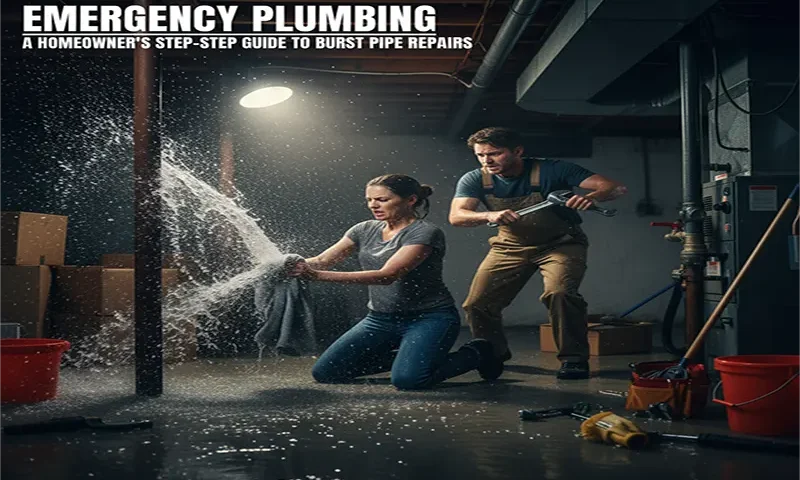

Emergency Plumbing: A Homeowner’s Step-by-Step Guide to Burst Pipe Repairs

A burst pipe is one of the most stressful experiences a homeowner can face. The sound of rushing water, the sight of pooling moisture, and the immediate panic regarding potential structural damage can make it difficult to think clearly. However, acting swiftly and calmly in the first few minutes is the single most effective way to minimize damage and protect your home.

This guide outlines exactly what to do—and what not to do—to handle a plumbing emergency until professional help arrives.

1. The Critical First 5 Minutes: Safety-First Protocol

When a pipe bursts, time is your greatest enemy. Follow these steps immediately, in this order.

A. Shut Off the Main Water Valve

You must stop the flow of water to prevent catastrophic flooding.

  • Locate the Valve: If you don’t already know where it is, check where the main water line enters your home—often in the basement, utility room, crawl space, or near the water meter.
  • Operate the Valve:
    • Ball Valves: Have a straight lever handle. Turn it a quarter-turn clockwise so the handle is perpendicular to the pipe.
    • Gate Valves: Have a round wheel handle. Turn it clockwise multiple times until it is fully closed.
  • Verify: Once off, turn on a faucet to confirm the water pressure has dropped and the flow has stopped.

B. Electrical Safety

Water and electricity are a lethal combination. If the burst pipe is near electrical outlets, appliances, or exposed wiring, you must cut the power.

  • Locate your circuit breaker panel and switch off the
READ MORE >>>
Bridging Eras: Elegant Victorian Restoration and Modernizing Strategies

Restoring a Victorian-era home—whether a Queen Anne, an Italianate, or a Gothic Revival—is an act of stewardship. These homes were designed for a social era defined by servant-led households, isolated kitchens, and labor-intensive domesticity. Modernizing them for 2026 living requires a delicate philosophy: “Respectful Modernism.” The goal is to ensure your home performs like a 21st-century asset while retaining the architectural soul that made you fall in love with it in the first place.

The Envelope & Efficiency

Victorian homes are notorious for being “leaky.” While modern codes favor air-tight construction, historic homes were built to “breathe” through their porous materials.

The biggest mistake is applying modern, rigid spray foam to historic walls, which can trap moisture and cause the framing to rot from the inside out. Instead, look for dense-pack cellulose insulation, which allows for a degree of vapor permeability while significantly boosting thermal performance.

Regarding windows, avoid the urge to replace original old-growth wood sashes with plastic. Original glass has a unique “wavy” character that cannot be replicated. Instead, restore the original sashes and install high-quality, custom interior storm window inserts. They are invisible from the street, highly energy-efficient, and preserve the original window frame.

The Kitchen & Bath Dilemma

Victorian kitchens were originally utility spaces, often tucked away, small, and dark. Bringing them into the modern era requires a design that respects the past while optimizing for contemporary chefs.

  • Kitchens: Favor “furniture-style” cabinetry that sits on legs or has toe-kicks that mimic baseboards, making the
READ MORE >>>