
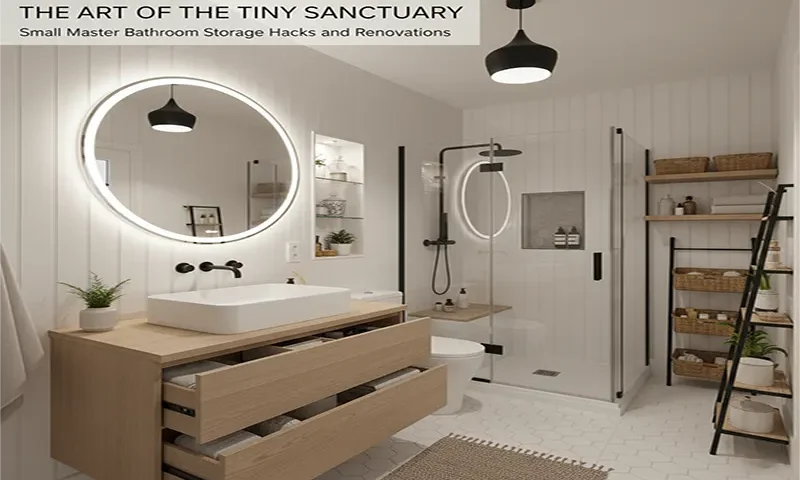
A master bathroom should be your personal sanctuary—a place to decompress. However, the “Small Master Bathroom Paradox” often turns this space into a stressful, cluttered closet. The good news? You don’t need more square footage to create a spa-like experience; you simply need more intentionality. By shifting to a philosophy of “curated minimalism,” where every inch is optimized, even the most cramped bathroom can feel expansive and luxurious.
1. The “Hacker’s” Toolkit: Immediate Upgrades
You don’t have to pick up a sledgehammer to start reclaiming your space. These non-structural hacks focus on reclaiming “dead zones.”
- Vertical Expansion: The most underutilized real estate in any bathroom is the wall space above the toilet and vanity. Use high-end, wall-mounted floating shelves that match your trim, or look for over-the-toilet units with closed cabinetry to hide clutter.
- Recessed “Niche” Storage: Don’t stop at the shower. Identify areas between wall studs—often found in vanity backsplashes or near the entry—and install recessed, framed shelving.
- Door and Dead-Space Optimization: The back of your master bathroom door is a prime spot for a heavy-duty, decorative hook rail for robes. Inside the vanity, utilize the door itself for shallow organizers—perfect for hair tools or makeup brushes.
- Countertop De-cluttering: The goal is to keep the counter as clear as possible. Consider installing a wall-mounted faucet, which can save up to 4 inches of counter depth, and mount your toothbrush and soap dispensers directly to the wall or mirror surround.
2. Strategic Renovation Moves
When you are ready for a deeper renovation, focus on structural changes that physically manipulate the room’s geometry.
- Recessed Shower Niches: A protruding shower caddy is a visual anchor that shrinks the room. A recessed niche—integrated directly into the wall cavity—creates functional storage that disappears into the architecture.
- Floating Vanities: By removing the vanity’s legs and base, you expose the floor underneath. This “lightness” creates the illusion of a larger footprint and makes the room feel significantly more spacious.
- Custom-Recessed Medicine Cabinets: Ditch the standard medicine cabinet. During a renovation, install wall-to-wall, custom-recessed medicine cabinets. When mirrored, these cabinets effectively double the perceived depth of the room while providing massive storage for daily essentials.
3. Lighting and Visual Expansion
In a small bathroom, shadows are the enemy. They create “visual noise” that makes the room feel cramped and unorganized.
- Backlit Mirrors: Use mirrors with integrated, ambient LED backlighting to create a “halo” effect. This pushes the wall back visually, making the room feel deeper.
- Under-Cabinet Lighting: Installing LED strips under a floating vanity adds a high-end, boutique hotel feel and ensures the floor area is illuminated, further accentuating the sense of space.
The “Dead Space” Hunt: Where to Find Storage
- The “Gap” Behind the Door: Is there a 6-inch gap behind your door when it’s open? That’s a full-height pantry space waiting to happen.
- Wall-Stud Cavities: Use a stud finder to identify the pockets between your wall studs. You can often open the drywall to create hidden, shallow shelving between the studs.
- Vanity Toe-Kicks: Install a shallow, flat drawer behind the toe-kick of your vanity to store flat items like extra towels or cleaning supplies.
4. The 2026 Material Palette: Bouncing Light
Your choice of materials can dictate how large a room feels. To expand a small master bathroom, prioritize light-reflecting surfaces.
- Glossy Tiles: Use large-format, high-gloss tiles for the walls. These act like mirrors, bouncing light back into the center of the room.
- Polished Finishes: Opt for polished chrome, nickel, or unlacquered brass hardware. These reflective surfaces provide small, high-intensity highlights that add luxury and visual interest without taking up physical space.
- Glass Partitioning: If you are updating your shower, prioritize a frameless, floor-to-ceiling glass panel rather than a curtain or a heavy frame. The unbroken line of sight will make your bathroom feel like one cohesive, flowing area.
Storage Efficiency Table: Impact Comparison
| Feature | Surface Area Impact | Storage Gained | Visual Impact |
| Floating Vanity | Low | Moderate | High (Floor exposure) |
| Recessed Niche | Zero (In-wall) | High | High (Hidden) |
| Over-Toilet Shelving | Moderate | Very High | Moderate |
| Wall-Mount Faucet | Very High | Negligible | High (Clean counter) |
Small does not mean “lesser.” It simply means “more intentional.” By choosing furniture that floats, storage that is recessed into the walls, and materials that bounce light, you can transform your cramped master bathroom into an efficient, spa-like sanctuary. Start small this weekend: clear your countertops entirely, and notice how much larger the room feels immediately. From there, you can prioritize the renovations that will bring the most lasting peace and organization to your daily routine.

