
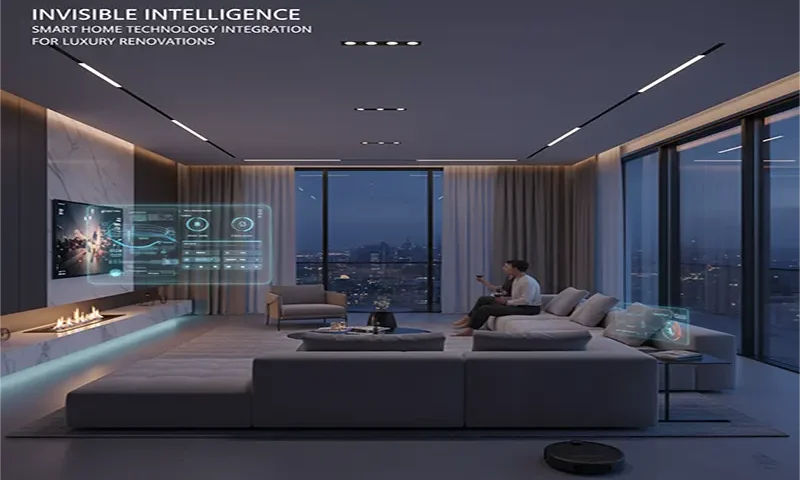
In the landscape of modern luxury living, true sophistication is no longer defined by the presence of technology, but by its absence. A high-end smart home should feel like a butler who is always present but never intrusive—a residence that anticipates your needs, secures your perimeter, and curates your environment with silent, invisible efficiency.
In 2026, luxury smart home integration has evolved beyond simple remote control. It is now about creating a cohesive, “invisible” ecosystem that elevates your lifestyle while maintaining the pristine aesthetic of your interior design.
The Foundation: Network & Infrastructure
Behind every “magical” automation is a rigorous technical backbone. In a luxury renovation, the network is the most critical infrastructure, ranking in importance alongside plumbing and electrical.
For a residence of this caliber, a standard ISP-provided router is insufficient. You require an enterprise-grade network—often featuring a fiber-optic backbone and a Wi-Fi 7 mesh system—to ensure zero-latency performance. Because smart homes now rely on a variety of low-power protocols like Thread and Matter, your integrator must plan for a robust network that can handle hundreds of devices simultaneously without compromising security. Cybersecurity is no longer an “option”—it is baked into the network architecture, protecting your digital life from external threats.
Seamless Integration: Beyond the App
The hallmark of a luxury smart home is that you shouldn’t need an app to “run” your house. The technology should be embedded into the very fabric of the building.
- Human-Centric Lighting: Forget manual dimmers. Modern luxury homes utilize circadian-rhythm lighting that automatically shifts color temperature from cool, energizing whites in the morning to warm, amber tones in the evening. This is achieved through discreet, trimless fixtures that vanish into the ceiling.
- Intelligent Climate Control: Zoned HVAC systems now operate with near-silent precision. By using occupancy-based sensors and predictive AI, your home adjusts temperatures to your exact preferences before you even walk into a room, all while managing energy efficiency across vast square footage.
- Motorized Shading: Precision-engineered, silent-motorized drapery that integrates with light sensors means your home “wakes up” as the sun rises and protects your furniture and privacy as it sets, all without you lifting a finger.
- Invisible Audio: Audiophile-grade sound is now achieved through plaster-over speakers—technologies that sit behind your walls or ceilings, delivering high-fidelity audio without a single grille visible.
Predictive & Proactive Intelligence
In 2026, reactive automation is considered “legacy.” Luxury homes are moving toward proactive assistance.
- Geofencing & Presence Detection: Utilizing advanced mmWave sensors—which detect motion even when you are sitting perfectly still—your home knows which rooms are occupied and manages the environment accordingly, turning lights and HVAC off the moment you exit.
- Scenario Orchestration: One-touch (or voice-activated) scenarios handle the complex. A “Good Morning” scene could simultaneously raise the shades, gently brighten the kitchen lighting, and start your preferred brew, while an “Away” scene secures all access points, resets the climate, and verifies that all major appliances are powered down.
Security & Peace of Mind
Security in a luxury home must be as uncompromising as its design. It should feel invisible but be relentlessly vigilant.
- Integrated Surveillance: High-resolution cameras are increasingly designed to blend into the home’s architecture, often featuring privacy-focused local AI processing (keeping your footage on-site rather than in the cloud).
- Frictionless Access: Biometric entry—such as facial recognition or fingerprint access—replaces keys, allowing for secure, log-tracked entry for you, your family, and trusted service providers.
- Proactive Leak Detection: Smart water sensors located near major plumbing fixtures can automatically shut off the main water supply if a leak is detected, potentially saving hundreds of thousands in damage before it even begins.
The Comparison: Standard vs. Luxury Integration
| Feature | Basic Smart Home | Luxury Integrated Home |
| Control | Multiple apps/Manual | Unified interface / Predictive AI |
| Connectivity | Standard Wi-Fi (Crowded) | Enterprise-grade Fiber / Wi-Fi 7 |
| Aesthetics | Visible devices (bulky hubs) | Invisible (Plaster-over / Hidden) |
| Lighting | Static / Dimming only | Circadian / Human-centric |
| Reliability | Cloud-dependent | Local processing / Backup systems |
Selecting the Right Integrator
The success of these systems hinges entirely on the professional you hire. You are looking for a Certified Home Technology Integrator—ideally one holding CEDIA (Custom Electronics Design and Installation Association) certification.
These professionals act as a bridge between the architect, the interior designer, and the electrical trades. They don’t just “install gadgets”; they manage the infrastructure, ensure future-proofing for next-generation technology, and guarantee that the final result is as reliable as it is beautiful.
Luxury smart home technology is no longer about showing off what your home can do; it is about how the home feels. By investing in an invisible, predictive foundation, you are not just buying technology—you are curating an environment that supports your health, secures your privacy, and simplifies your life. In the luxury renovation of 2026, the best technology is the kind you never have to think about, because it is already doing the thinking for you.

