
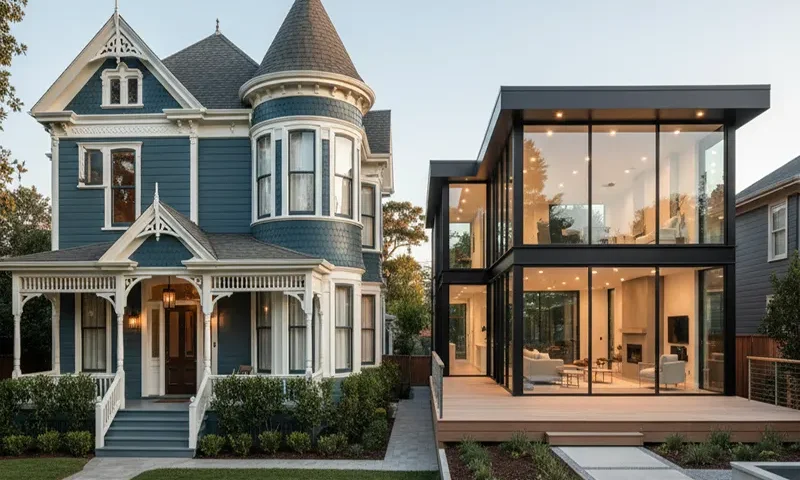
Restoring a Victorian-era home—whether a Queen Anne, an Italianate, or a Gothic Revival—is an act of stewardship. These homes were designed for a social era defined by servant-led households, isolated kitchens, and labor-intensive domesticity. Modernizing them for 2026 living requires a delicate philosophy: “Respectful Modernism.” The goal is to ensure your home performs like a 21st-century asset while retaining the architectural soul that made you fall in love with it in the first place.
The Envelope & Efficiency
Victorian homes are notorious for being “leaky.” While modern codes favor air-tight construction, historic homes were built to “breathe” through their porous materials.
The biggest mistake is applying modern, rigid spray foam to historic walls, which can trap moisture and cause the framing to rot from the inside out. Instead, look for dense-pack cellulose insulation, which allows for a degree of vapor permeability while significantly boosting thermal performance.
Regarding windows, avoid the urge to replace original old-growth wood sashes with plastic. Original glass has a unique “wavy” character that cannot be replicated. Instead, restore the original sashes and install high-quality, custom interior storm window inserts. They are invisible from the street, highly energy-efficient, and preserve the original window frame.
The Kitchen & Bath Dilemma
Victorian kitchens were originally utility spaces, often tucked away, small, and dark. Bringing them into the modern era requires a design that respects the past while optimizing for contemporary chefs.
- Kitchens: Favor “furniture-style” cabinetry that sits on legs or has toe-kicks that mimic baseboards, making the kitchen look like a collection of period-appropriate pieces rather than a sterile laboratory. Use panel-ready appliances—hiding your refrigerator and dishwasher behind custom wood fronts—to keep the visual focus on the architectural millwork rather than stainless steel surfaces.
- Baths: Balancing modern plumbing needs with historic charm is an art. Don’t sacrifice the clawfoot tub; instead, treat it as the “sculpture” of the room. Pair it with period-appropriate tile work like basketweave or encaustic patterns, which provide a classic Victorian floor texture while allowing for modern, waterproof sub-flooring.
Lighting and Connectivity
The greatest “hidden” challenge of a Victorian restoration is the electrical infrastructure. If your home still has knob-and-tube wiring, a total overhaul is not optional—it is a fire safety necessity.
When upgrading, use the opportunity to install modern smart-lighting systems. You can use dimmers that mimic the warm, golden glow of gas lighting (look for bulbs in the 2200K–2700K range) to keep the ambiance period-correct. Furthermore, modern technology like Wi-Fi access points and smart-home hubs can be strategically concealed inside existing cabinets or behind custom-built crown molding to ensure your 21st-century connectivity doesn’t clutter your 19th-century aesthetics.
Color and Atmosphere: The Curated Eclectic
Avoid the “cluttered museum” look. Victorian homes had high ceilings, intricate trim, and significant personality—they don’t need a lot of extra “stuff.”
In 2026, the trend is toward “Curated Eclectic” design. Use deep, saturated, period-correct paint colors—jewel-toned teals, rich aubergine, or ochre—on walls to create intimacy. Pair these bold backdrops with clean-lined, modern furniture that offers a sharp contrast to the ornate Victorian millwork. This allows the historic architecture to stand out as the primary “feature” of the room, while your modern furniture provides comfort and utility.
The Victorian Room vs. The Modern Functional Equivalent
| Feature | Victorian Original | Modern Functional Equivalent |
| Kitchen | Isolated, dark, servant-operated | Integrated, “furniture-style” layout |
| Lighting | Gas jets / Early electric | Warm-spectrum (2200K) LED smart-lighting |
| Windows | Single-pane wood sashes | Restored sashes + Interior storm inserts |
| Climate | Fireplace heating / Passive cooling | Zoned HVAC with hidden, low-profile vents |
3 Things You Should NEVER Replace
- Original Molding/Trim: The intricate profile of Victorian millwork is nearly impossible to replicate at a reasonable cost.
- Fireplace Mantels: These are the jewelry of the home; they anchor the entire room’s design.
- Staircase Banisters: The craftsmanship of historic hand-turned woodwork is a disappearing art—preserve it at all costs.
Restoring a Victorian home is a long-term relationship. It requires you to act as an active steward, making decisions that prioritize the longevity of the structure. By focusing on reversible upgrades—improving efficiency without stripping historic fabric, and hiding modern technology within period-appropriate design—you ensure that your home remains a vibrant, functional space that is ready for the next hundred years.

