
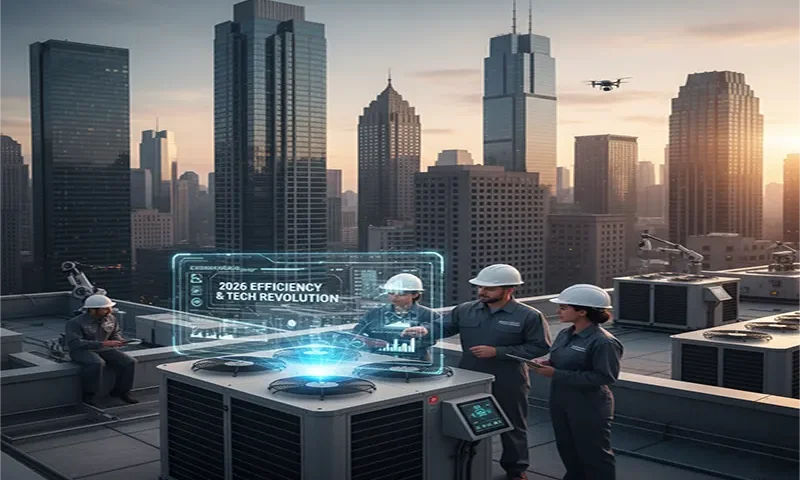
The commercial real estate landscape in 2026 is defined by a “perfect storm” of regulatory mandates, rising operational costs, and a fundamental shift in how we define a “healthy” office. The days of treating HVAC as a “set-it-and-forget-it” utility are over. Today, the HVAC system is a strategic asset essential for tenant retention, ESG (Environmental, Social, and Governance) compliance, and workforce productivity.
For facility managers and developers, selecting the right commercial HVAC contractor now requires a focus on future-proofing against the 2026 refrigerant transition and mastering the integration of artificial intelligence.
Selecting a Future-Ready Contractor
In 2026, the criteria for vetting a contractor have shifted from basic mechanical repair to high-tech systems integration. As of January 1, 2026, the EPA has prohibited the installation of new systems using high-GWP (Global Warming Potential) refrigerants like R-410A.
The “New Standard” Vetting Checklist
When interviewing contractors for your office building, ensure they possess the following:
- A2L Certification: Technicians must be specifically trained in handling “mildly flammable” A2L refrigerants (like R-32 and R-454B). This includes using spark-resistant tools and specialized recovery equipment.
- BAS/BMS Fluency: Your contractor should be an expert in Building Automation Systems. They must know how to integrate HVAC hardware with BACnet or Modbus protocols to allow for centralized, data-driven control.
- Simulation-First Modeling: Modern contractors use digital twins or energy modeling software to predict how a system upgrade will perform before a single bolt is turned.
The Technology Suite of 2026
Modern office climate control is no longer just about moving air; it’s about intelligent response. Three core technologies are dominating the 2026 market:
1. AI & IoT Integration
Predictive maintenance has replaced reactive repair. IoT sensors now monitor equipment vibration, refrigerant pressures, and energy spikes in real-time. AI algorithms analyze this data to flag a failing compressor weeks before a breakdown occurs, allowing for “invisible” repairs that never disrupt the tenant experience.
2. VRF & High-Efficiency Heat Pumps
The electrification of heat is in full swing. Variable Refrigerant Flow (VRF) systems and high-performance heat pumps have largely replaced traditional boiler-and-chiller setups. These systems allow for simultaneous heating and cooling in different zones of an office—perfect for modern, glass-heavy floor plans with varying solar loads.
3. Demand-Controlled Ventilation (DCV)
Energy waste often occurs when HVAC systems treat a half-empty office like a full one. DCV uses CO2 sensors to detect real-time occupancy, only pulling in fresh outside air when and where it is needed. This reduces the “energy tax” of heating or cooling large volumes of outdoor air.
The IAQ (Indoor Air Quality) Gold Standard
Post-pandemic air quality standards have codified into law and certification. In 2026, office buildings chasing WELL or RESET certifications must meet strict Indoor Air Quality (IAQ) benchmarks.
High-performing contractors are now installing MERV-13 or higher filtration as a baseline. Furthermore, humidity control has become a primary focus; maintaining a 40–60% humidity range is now scientifically linked to reduced viral transmission and improved cognitive function for office workers. A contractor who cannot provide real-time IAQ dashboarding for your tenants is already behind the curve.
Financial Models: From CapEx to HVAC-as-a-Service
The most significant shift in 2026 isn’t just mechanical—it’s financial. Many office buildings are moving away from massive capital expenditures (CapEx) in favor of HVAC-as-a-Service (HaaS).
In this model, the building owner pays a monthly subscription for “comfort.” The contractor owns and maintains the equipment, bearing all the risk of repair and energy inefficiency. This “Outcome-Based” approach aligns the contractor’s incentives with the building’s goals: if the system is inefficient or breaks down, the contractor loses money, not the owner.
2026 Maintenance: Legacy vs. Smart
| Feature | Legacy Maintenance (Pre-2024) | Smart Maintenance (2026) |
| Schedule | Calendar-based (Quarterly) | Data-based (Predictive/Real-time) |
| Refrigerant | R-410A (High GWP, Rising Cost) | R-32 / R-454B (Low GWP, Future-proof) |
| Diagnostics | Manual gauges and “ear-testing” | AI-driven fault detection (FDD) |
| Air Quality | Basic filtration (MERV-8) | Active monitoring (MERV-13 + Sensors) |
The R-410A Sunset: What Facility Managers Need to Know
While existing R-410A systems can still be serviced, the 40% production cut enacted in early 2026 has caused the price of “virgin” refrigerant to triple. If your building relies on aging R-410A units, a single major leak could now cost as much as a partial system replacement. 2026 is the year to begin your phased transition plan.
In 2026, an office building’s HVAC system is a direct reflection of its management’s sophistication. By partnering with a contractor who understands A2L safety, AI-driven diagnostics, and modern financial models like HaaS, you do more than just cool a room. You protect your asset’s value, ensure regulatory compliance, and provide a healthy environment that actually brings people back to the office.

