
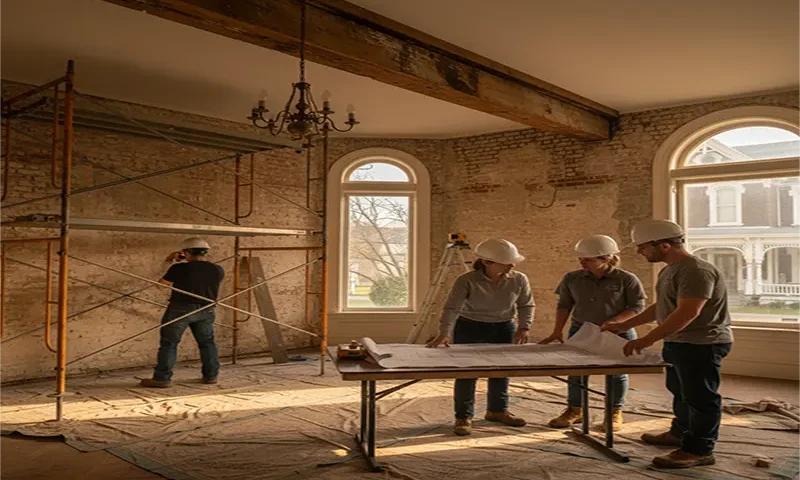
Owning a historic home—specifically one built prior to 1940—is a unique privilege that comes with an immense responsibility: stewardship. Unlike modern suburban builds, historic homes are organic entities that respond to environmental changes in specific, often temperamental ways. When structural issues arise, you face the “Historic Home Structural Paradox”: modern building codes, which favor rigid, high-strength materials, often clash with the flexible, breathable systems used in historic construction.
Hiring a general contractor for structural repairs on a historic asset is not the same as hiring for a new build. It requires a contractor who understands that the goal is not merely “fixing” a problem, but stabilizing and preserving the integrity of the original architecture.
The Anatomy of Historic Structural Failure
Historic homes were built with different materials and philosophies. Common structural issues include:
- Fieldstone Foundation Seepage: Many pre-1900 foundations were built using fieldstone and lime mortar. They weren’t designed to be “waterproof” in the modern sense; they were designed to “breathe.” Sealing these with modern, rigid Portland cement can trap moisture, causing the stone to spall and the foundation to fail.
- Balloon-Frame Rot: Many historic homes utilize “balloon framing,” where studs run continuously from the foundation to the attic. This allows fire to spread rapidly and provides a pathway for water and rot to travel vertically, often undetected.
- Settling and Unreinforced Masonry: Historic brick buildings often lack the steel reinforcement of modern masonry. Over a century, natural settlement can lead to distinctive “stair-step” cracks that require specialized brick-and-mortar stabilization.
Vetting the “Preservationist” General Contractor
Standard licensing is a baseline, not a qualification. When vetting a contractor for historic structural work, look for these four pillars:
- Experience with Period Materials: Ask them about lime mortar. If they suggest using modern high-strength cement for historic brickwork, walk away. Modern mortar is too hard; it will cause the softer historic brick to crack under stress.
- Sub-Contractor Network: A great general contractor doesn’t do it all. They should have a deep roster of specialized artisans—timber framers, stone masons, and ironworkers—who understand historic techniques.
- Regulatory Knowledge: Do they know how to navigate your local Historical Commission or Landmarks Board? They should be prepared to handle applications for “Certificates of Appropriateness.”
- Preservationist References: Ask for a portfolio of projects where the structural repair was “invisible” or respectful of the historic aesthetic.
The Assessment Phase: Engineers First
Never let a general contractor be the sole person assessing structural integrity. Hire a structural engineer who specializes in historic buildings first. A general contractor is an executor; an engineer is a diagnostician. The engineer will provide a report that prevents “quick fix” consultations—which are often dangerous for historic assets—and establishes the technical requirements the contractor must follow.
The Construction Phase: The Principle of Reversibility
In modern historic preservation, the gold standard is reversibility. Any modern intervention—such as steel bracing or carbon-fiber reinforcement—should ideally be installed in a way that, if removed in the future, it would not permanently damage the original historic fabric.
Modern “Quick Fix” vs. Historic-Sensitive Solution
| Issue | The “Quick Fix” (Avoid) | The Historic Solution |
| Foundation Cracks | Injecting rigid epoxy/urethane | Pointing with breathable lime mortar |
| Sagging Joists | Replacing with modern pressure-treated lumber | Sistering with matching vintage-dimension wood |
| Masonry Decay | Applying a waterproof sealant | Removing degraded mortar and re-pointing |
| Floor Leveling | Aggressive hydraulic jacking | Slow, multi-month incremental lifting |
Financial Realities: The Contingency Premium
Historic structural repair is rarely a “fixed-price” venture. Because you are dealing with hidden conditions—such as rot inside a wall cavity that only becomes visible once the siding is removed—you should expect “unforeseen condition” premiums.
Pro Tip: Budget a 20-30% contingency fund specifically for structural work on homes over 80 years old. If the contractor isn’t comfortable discussing the uncertainty of what lies behind historic walls, they likely lack the experience to manage the project successfully.
The 5 Questions Every Owner Should Ask a Contractor
- “How do you distinguish between Portland cement and lime mortar, and when do you use each?”
- “Can you provide references for homes in this neighborhood built before 1940?”
- “How will you protect the original trim and finishes while the structural work is underway?”
- “What is your experience working with the local Historical Commission/Landmarks Board?”
- “How do you handle hidden rot or structural issues discovered mid-project?”
As a historic homeowner, you are a temporary custodian of a legacy. Structural repairs are not just maintenance; they are a vital intervention to ensure the home survives for the next century. By prioritizing preservation-minded professionals, demanding engineering oversight, and honoring the principle of reversibility, you ensure that your home remains a living piece of history rather than a modern reconstruction.

